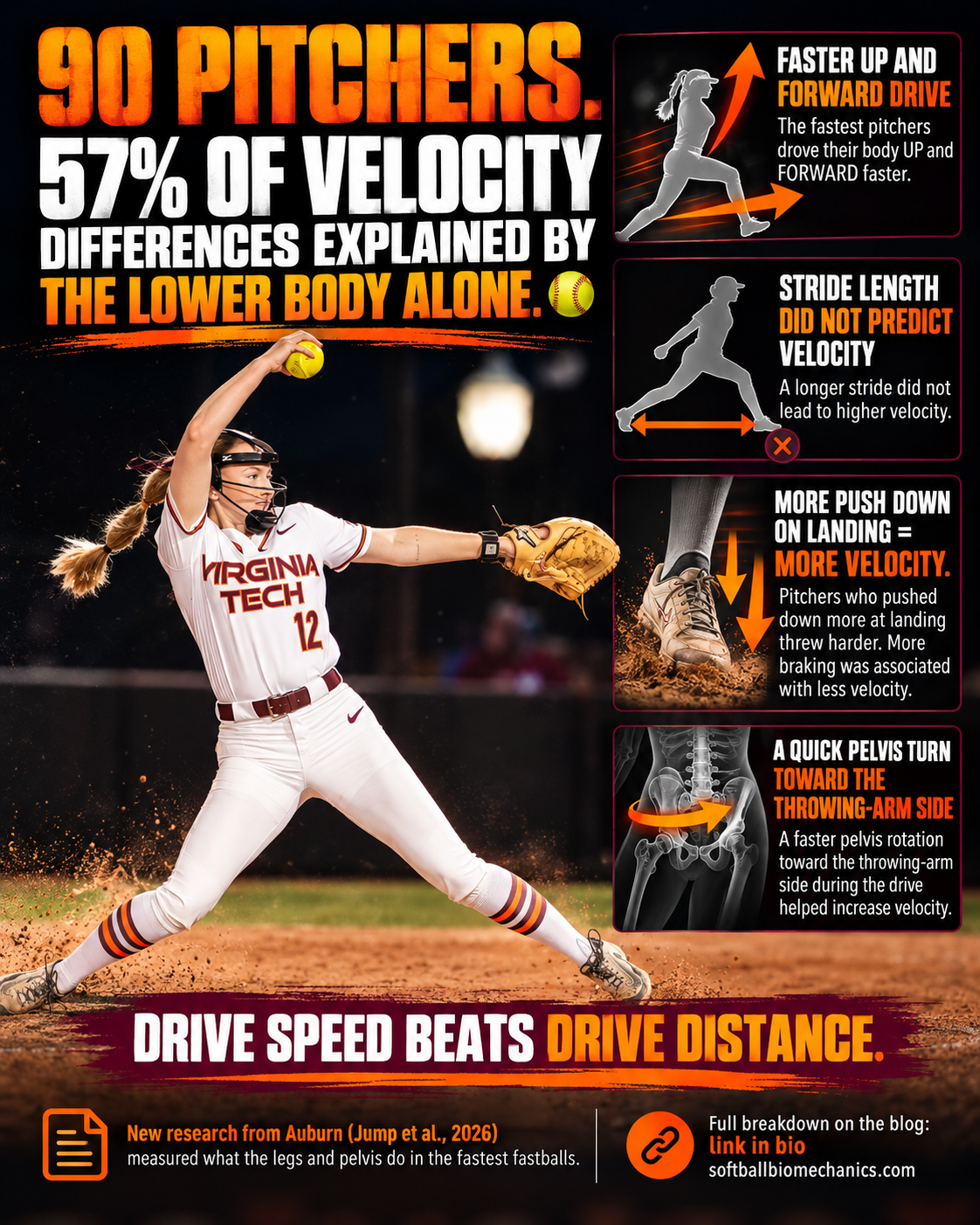

The purpose of the master’s thesis by Haydu (1999) was to examine how the lower body moves and how much force it produces during different types of windmill softball pitches. Five healthy, right-handed collegiate-level female pitchers participated in the study. Each pitcher threw five different pitches: fastball, change-up, dropball, curveball, and riseball. The researchers used a force plate to measure ground reaction forces (GRFs) under the stride leg at 1000 Hz and a video camera (60 Hz) to record lower-body movement. Reflective markers were placed on key joints (hip, knee, ankle, foot, and shoulder) to measure joint angles and motion. The researchers analyzed stride length, ball velocity, joint angles at foot contact, maximum and minimum joint angles, timing of those angles, and three main force variables: first peak force (F1), second peak force (F2), and maximum braking force. Statistical tests (ANOVAs) were used to compare differences between pitch types.
They found:
Kinematics (Movement Findings)
-
Significant differences were found between pitch types for:
-
Maximum and minimum hip, knee, and ankle angles
-
Joint angles at contact (hip and knee)
-
-
Stride length differed by pitch type:
-
Longest stride = Riseball
-
Shortest stride = Change-up
-
-
Longer strides were associated with a more forward-leaning body position
-
Shorter strides (change-up, dropball) resulted in a more upright posture
-
Slower ball velocities tended to occur with a more upright body position
Kinetics (Force Findings)
-
Peak vertical forces during pitching were:
-
Higher than walking and low-impact aerobics
-
Similar to distance running and high-impact aerobics
-
Lower than basketball or volleyball jump landings
-
-
Braking forces during pitching were:
-
Higher than walking and running
-
Similar to some basketball landing tasks
-
-
Riseball produced the highest braking forces
-
Change-up produced the lowest braking forces
-
Pitches with higher first peak forces (F1) also showed higher braking forces
Implications: This study showed that the lower body plays a major role in producing force and controlling movement during the windmill pitch. Different pitches require different stride lengths and body positions. Pitches like the riseball and fastball use longer strides and more total body movement, which appear to help generate more force and higher ball speeds. In contrast, pitches like the change-up use shorter strides and a more upright posture, which may reduce force production and ball velocity.
The study also found that the stride leg experiences large braking forces when it contacts the ground. These forces are higher than those seen in normal daily activities and are similar to forces seen in running. This suggests that the stride leg must absorb a significant amount of force in a short time, which may contribute to injury risk if mechanics are poor. The author concludes that understanding lower-body mechanics can help coaches teach better technique, help trainers reduce injury risk, and help strength coaches design sport-specific training programs. Overall, the study highlights that pitching is not just an arm motion — it is a full-body movement that relies heavily on the legs.
Also…
Foot and ankle health can prevent a lot of injuries that occur up the chain. The ankle must be mobile, but stable and often these elements change in pitchers over the course of the season. Often times, rehab turned to “pre-hab” can help stop problems before they start. Here is a good post from ThePrehabGuys about ankle rehab.
Newsletter subscribers got this review a week early. Sign up for the Pitch Better Newsletter to get each week’s research first.