
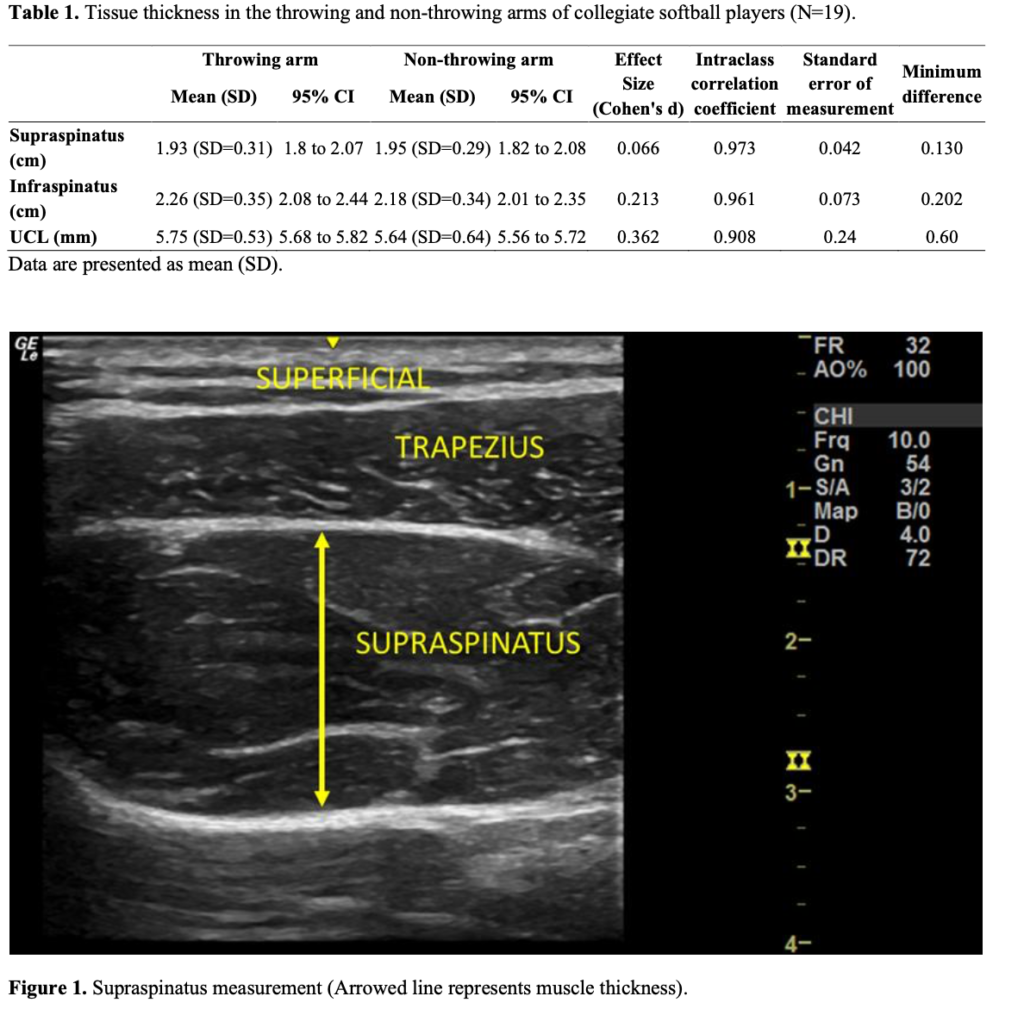
In a brand-new article, Burton et al. (2025) studied 19 NCAA Division I female collegiate softball players to determine whether repetitive overhead throwing led to long-term structural changes in the shoulder and elbow. Only non-pitchers were included, since pitchers primarily throw underhand. Using ultrasound imaging, the researchers measured the thickness of three structures in both arms: the supraspinatus muscle, the infraspinatus muscle, and the ulnar collateral ligament (UCL). All measurements were taken with the athletes seated and relaxed, following standardized imaging procedures to ensure accuracy. Two images were collected for each structure and averaged. The throwing arm was compared to the non-throwing arm within each athlete using paired t-tests to see if chronic throwing caused tissue thickening.
They found:
- No significant differences in tissue thickness between the throwing and non-throwing arms
- Supraspinatus thickness was nearly identical between arms (p = 0.401)
- Infraspinatus thickness showed no meaningful difference (p = 0.236)
- UCL thickness was similar in both arms (p = 0.171)
- Effect sizes were small, indicating minimal structural asymmetry
- Ultrasound reliability was high (ICC values > 0.90), showing measurements were consistent
Implications: The authors concluded that repetitive overhead throwing in collegiate female softball players does not appear to cause chronic thickening of the posterior rotator cuff muscles or the ulnar collateral ligament. These findings suggest that the throwing demands experienced by most non-pitching softball players may not be high enough to stimulate structural hypertrophy in these tissues. The authors note that the rotator cuff muscles mainly act as stabilizers rather than prime movers, which may limit their potential for size increases. Similarly, the lack of UCL thickening contrasts with findings in baseball pitchers, likely due to differences in throwing frequency, velocity, and joint loading. The authors emphasize that the absence of structural changes does not mean these tissues are unaffected by throwing, as adaptations may occur through neuromuscular control or tissue stiffness rather than size. They also caution that position-specific demands and throwing volume should be considered in future studies to better understand injury risk and adaptation in softball athletes.
Also…
Here is a good example of how a good exercise from another sport can have crossover for softball pitching. The Fit For Golf channel has some good stuff on rotation you should check out.