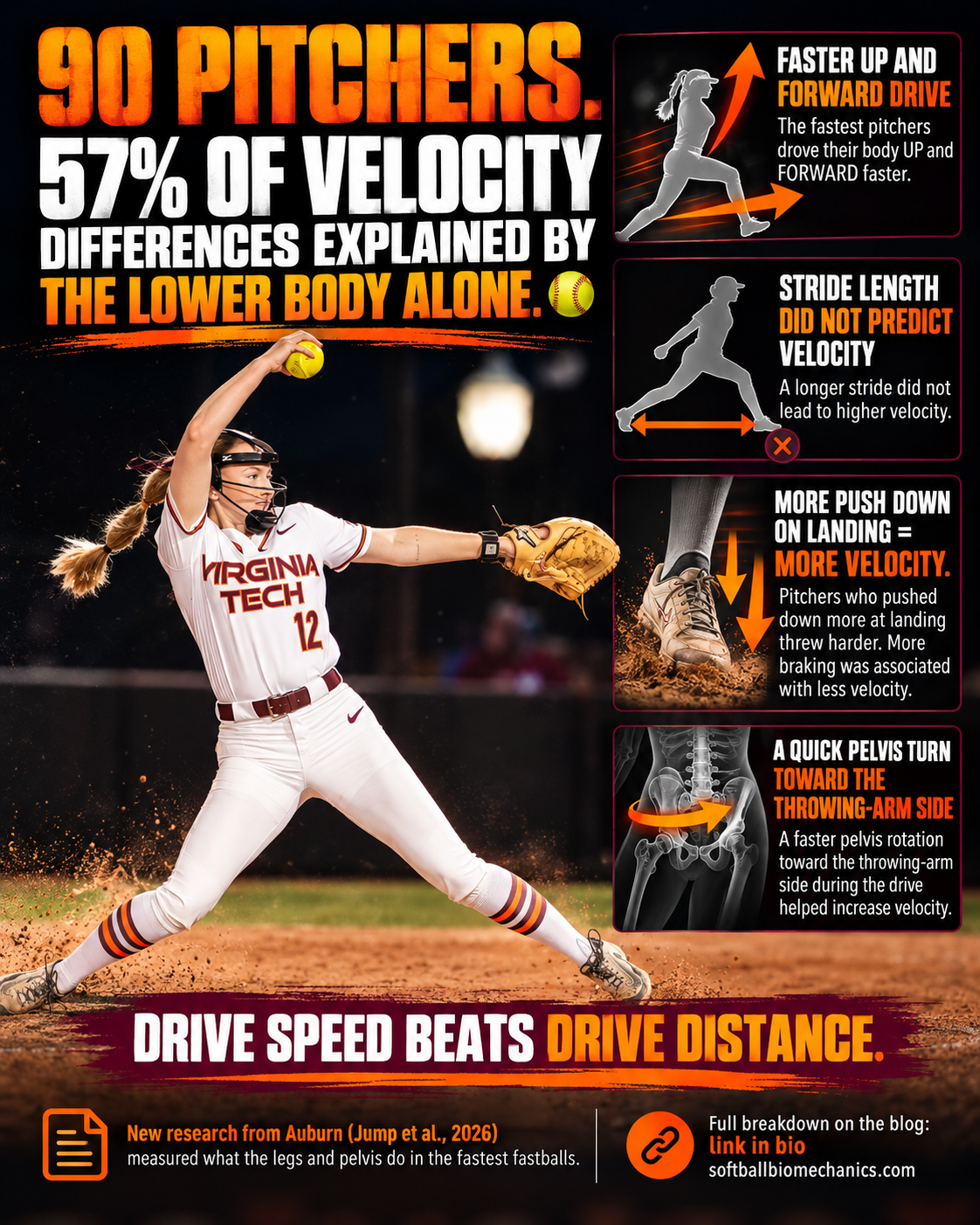

This week’s article will pivot away from the body composition conversation (I will be back soon) to a novel concept called Rate of Force Development (RFD). RFD is the increase in force over time. In their article, Drive Leg Ground Reaction Forces and Rate of Force Development Drive Leg Ground Reaction Forces and Rate of Force Development Over Consecutive Windmill Softball Pitches Over Consecutive Windmill Softball Pitches, Pletcher et al. (2022) assessed the RFD of 14 high school softball pitchers over the course of a simulated game. They measured the first pitch of each simulated inning (15 pitches per inning for 7 innings). They found:
- There were no significant differences in RFD over the 7 simulated innings.
- There were no significant differences in pitch velocity over the 7 simulated innings.
- There was no relationship between RFD and pitch velocity.
Implications: First, the average pitch velocity was around 49 mph, which means that these were likely not high-level pitchers, even for high school. This study measured only the RFD of the dominant leg of each pitcher. They did not measure the other half of the pitcher’s launch which comes from the non-dominant leg. They did not measure the plant leg either, which I think they probably should have. One trend that keeps coming up in studies that measure pitchers over simulated games is that a pitcher’s biomechanics don’t change significantly over the course of a game, or even a double header. No one has tried to measure changes in back-to-back days, so maybe that should be next. This study also illustrates another trend in research: the drive leg is not a significant contributor to velocity. We will get into that in future newsletters.
People to Follow
I enjoyed a couple of posts this week. One was for hip mobility by Vernon Griffith that’s worth a look. Another is a good one on thoracic spine mobility by Fit Moral. Give those a look.
More…
I had a good conversation about how to interpret biomechanics articles. When I first started reading softball studies, I noticed that the average velocities were sub-par. In many major studies, average velocities have been reported at less than 55 mph. Then I did a study for my DIS with some pitchers that I also had game data. With all the markers, and the setting, I noticed that pitchers who were 70+ mph in games were struggling to throw harder than 62 mph. I am hopeful to change some of this with my own research, but if you are reading an article and wondering why the velocities are so low, just know that’s probably why. That said, in today’s article, 49 mph is still very low.