
The purpose of Barfield and Oliver (2019) Sport Specialization and Single-Legged–Squat Performance Among Youth Baseball and Softball Athletes was to find out whether sport specialization in youth throwing athletes affected how well they controlled the trunk during a single-leg squat (SLS). The study, published in the Journal of Athletic Training, tested 49 youth athletes (23 baseball, 26 softball; mean age 12.96 ± 2.32 years; none injured in the previous 6 months; the paper doesn’t report a breakdown by sex). Using a health history form, the researchers grouped athletes three ways: (1) 8 or more months a year in season, (2) 8 or more months a year training for baseball or softball, and (3) specialized, meaning 8 or more months in season and having quit another sport. Wearing 14 electromagnetic sensors (trakSTAR, 100 Hz), each athlete performed one SLS on each leg in random order. Trunk lateral flexion (side lean), trunk flexion (forward lean), and trunk axial rotation were measured at 45° of knee flexion on the way down, at peak knee flexion, and at 45° on the way up, separately for the throwing-arm-side and glove-side legs. Groups were compared with multivariate tests (MANOVAs) followed by Bonferroni-corrected ANOVAs.
They found:
Training Time Mattered, Not Season Length (KEY FINDING)
- Athletes who trained 8+ months a year for baseball or softball showed better trunk control during the SLS than those who trained less
- Two of the three trunk measures differed by training time:
- Trunk lateral flexion (p = .020); training time explained about 31% of the variance
- Trunk flexion (p = .021); again about 31% of the variance
- The authors had predicted the opposite: that specialized athletes would show less trunk control
Year-round training, not year-round games, went with a steadier trunk.
Less Forward Lean at the Bottom of the Squat
- At peak knee flexion, the 8+ months training group leaned forward about 12°, vs. about 23° for those who trained less:
- Throwing-arm-side leg: 12.11° vs. 22.86° (p = .019)
- Glove-side leg: 12.51° vs. 23.37° (p = .023)
- The gap held on the way back up:
- Throwing-arm-side leg: 3.32° vs. 11.45° (p = .034)
- Glove-side leg: 4.04° vs. 13.27° (p = .036)
- No difference on the way down (p = .476 and p = .457)
The difference showed up at the bottom of the squat and on the way back up, the hardest part of the movement.
Less Side Lean, but Only on the Glove-Side Leg
- Athletes leaned toward the stance leg no matter which leg they squatted on, which matches studies in other groups
- On the glove-side leg, the 8+ months training group stayed close to upright:
- Peak knee flexion: 0.08° vs. 6.08° of side lean (p = .044)
- Way up: 0.76° vs. 4.98° (p = .027)
- On the throwing-arm-side leg, side lean didn’t differ (p = .672 to .918)
Side lean on the glove-side leg is where the training group stood out.
Playing Year-Round and Quitting Other Sports Showed No Effect
- 29 athletes were in season 8+ months, 28 trained 8+ months, and 16 met the specialized definition
- Months in season: no differences in side lean (p = .383), forward lean (p = .094), or rotation (p = .433)
- Specialized: no differences in side lean (p = .888), forward lean (p = .120), or rotation (p = .343)
- Trunk axial rotation didn’t differ by training time either (p = .780)
Just playing more games didn’t build trunk control, and it didn’t take it away either.
A Statistical Caveat
- The overall (multivariate) tests for training time were significant (p = .020 and p = .021)
- The follow-up tests used a Bonferroni-corrected threshold of p ≤ .008, and none of the individual angle comparisons reached it (the lowest was p = .019)
Treat the specific angle differences as a clear pattern, not a settled fact.
Implications: The authors concluded that the results fit the SAID principle (specific adaptation to imposed demands): athletes who spent 8 or more months a year training for their sport showed more control of the lumbopelvic-hip complex (LPHC), the spine, pelvis, hips, and surrounding muscles, during the SLS. Surprisingly, spending 8 or more months in season, or specializing after quitting another sport, made no difference. Their message to clinicians is that the neuromuscular control needed for a dynamic task like the SLS can be built through training rather than strict sport participation. In theory, an athlete who can stabilize the LPHC in an SLS is more likely to use an efficient kinetic chain when throwing. The authors named several limitations. They didn’t know what the training programs actually included, so “months training” may also cover general athletic development or rest. They didn’t account for position, the number of throws or swings, practices, or games. Baseball and softball athletes were analyzed together even though their pitching motions differ (the authors grouped them because softball players also throw overhand on defense and in warm-ups). Specialization came from a questionnaire, and ages varied with no measure of maturation. Future research should collect training details, injury history, and throw and swing volume, and connect SLS performance to segment sequencing in the throw.
Key Takeaways
- Train it, don’t just play it. Athletes who trained 8+ months a year had steadier trunks in the SLS; months in season alone made no difference.
- Watch the bottom of the squat. The biggest gap was at peak knee flexion: about 12° of forward trunk lean vs. about 23°.
- Test both legs. Side lean differed only on the glove-side leg, so one side can hide a problem the other doesn’t show.
- Use the SLS as a screen. The authors note it has been used and validated as a clinical test of postural control and LPHC stability, including in baseball and softball athletes.
- Keep it in context. This was 49 youth baseball and softball athletes (not only pitchers), and the individual angle differences didn’t clear the corrected significance threshold.
Important Biomechanics Connection
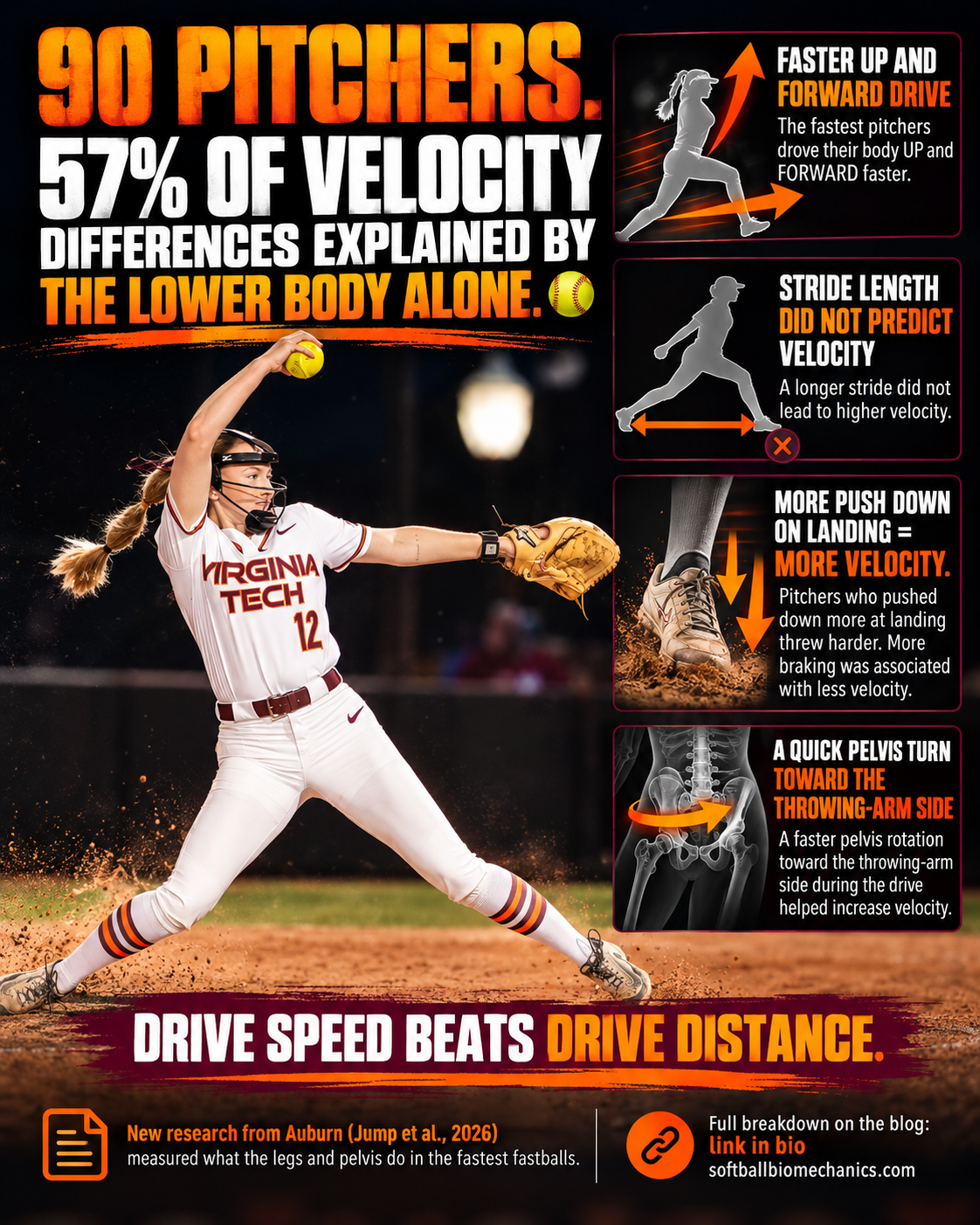
This paper sits right in the middle of the kinetic chain. Energy has to travel from the ground, through the legs, pelvis, and trunk, to the arm, and the LPHC is the link in the middle. If the trunk tips forward or sideways while an athlete balances on one leg, that’s a leak in the chain before the arm is even involved. We’ve looked at the single-leg squat before with Everhart et al. (2023) on collegiate pitchers and Brittain et al. (2020) on youth softball players (November 21, 2024), and at the pelvis and trunk in the Pelvis Overview (September 11, 2025) and T-Spine Overview (September 18, 2025). It also connects to the lower body and pitch speed in Jump et al. (2026) (October 15, 2026). One caution: this study grouped baseball and softball athletes together, and softball ≠ baseball. The windmill pitch and the overhand throw are different motions, so I’d like to see this repeated with softball pitchers alone. In my work on lower-body force production, I want pitchers to control the trunk over one leg before we ask them to produce more force through it.
Also…
This week I want to point you to this post from @Fred__Duncan on X. This post illustrates the different types of plyometric jumps in the progression of intensity that each athlete warrants. It’s good to familiarize yourself with these different levels of jumps to help progress your athletes.
Newsletter subscribers got this review a week early. Sign up for the Pitch Better Newsletter to get each week’s research first.